
Low-Carbon Hydrogen: Toward a Sustainable Reshaping of Global Geopolitical and Energy Equilibria
A silent but systemic disruption of the energy landscape
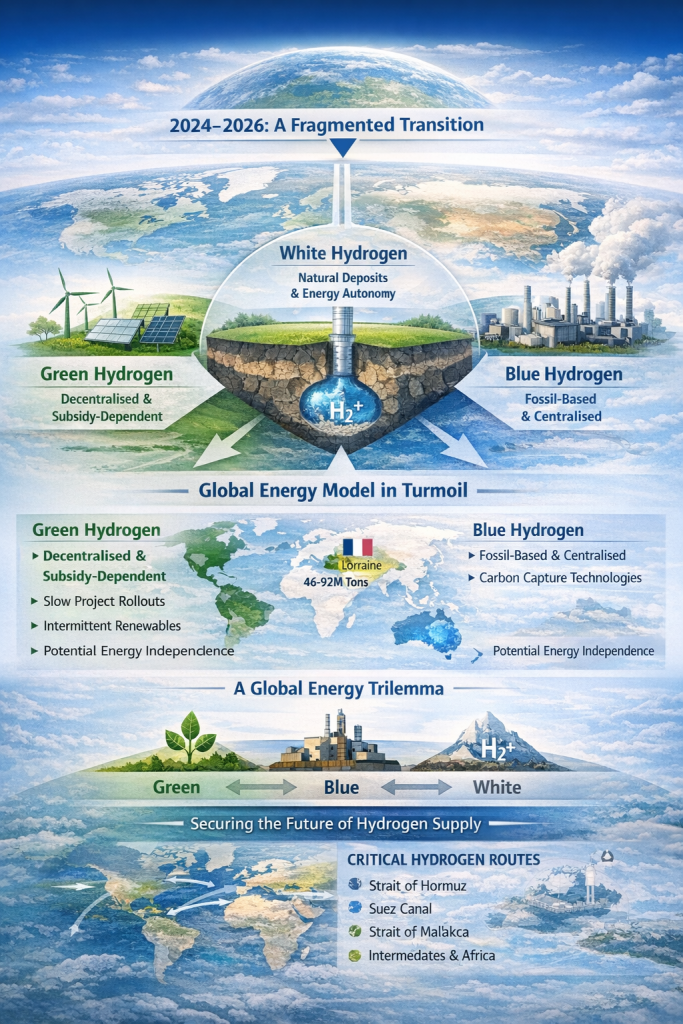
Between 2024 and 2026, the global low-carbon hydrogen market experienced a major inflection that challenges the trajectories anticipated at the beginning of the decade. Where forecasts assumed a linear rise of green hydrogen, the reality reveals a far more fragmented dynamic structured around three competing pathways.
On one hand, blue hydrogen is emerging as a pragmatic extension of the existing gas model, allowing major hydrocarbon producers to preserve their influence. On the other hand, green hydrogen, despite being at the core of public policies, is struggling to reach large-scale industrialisation. Finally — and this is the most structural shift — the emergence of white hydrogen is profoundly reshaping the scarcity assumptions that have so far underpinned energy strategies.
This reconfiguration goes beyond a technological evolution: it is redefining geopolitical balances by introducing a new form of competition between centralised and decentralised energy production models.
White Hydrogen
(autonomy / geological disruption)
▲
│
│
│
Green Hydrogen ◄─────┼─────► Blue Hydrogen
(decentralised)      │      (centralised / fossil-based)
│
▼
Global energy model
White hydrogen: from scientific anomaly to geopolitical lever
Until 2023, natural hydrogen was largely considered a geological curiosity with no industrial potential. This assumption has been abruptly challenged by a series of converging discoveries worldwide.
The French case is a turning point. The identification of a major deposit in Lorraine, estimated between 46 and 92 million tons, positions France as a potential key player. Beyond its scale, this discovery is significant because it suggests that white hydrogen may be geologically widespread rather than exceptional.
Similar signals are emerging in the United States, Australia, Tanzania, and Albania, alongside a rapid rise in private actors specialised in exploration. This trend reflects a shift in perception: white hydrogen is no longer a scientific hypothesis but a strategic asset undergoing industrial validation.
Economically, its potential cost — significantly lower than both green and blue hydrogen — enhances its attractiveness. More importantly, it introduces a major disruption: the possibility for certain countries to achieve energy autonomy without relying on intermittent renewables or fossil fuel supply chains.
Green hydrogen: constrained deployment due to structural limitations
In parallel, green hydrogen is facing a widening gap between political ambitions and industrial reality. Despite massive announcements, the rate of project completion remains extremely low.
This gap is explained by several structural constraints. The business model remains fragile, heavily dependent on public subsidies and competitive renewable electricity prices. In addition, operational challenges related to energy intermittency, infrastructure availability, and complex value chains further slow deployment.
Examples such as Chile and Morocco illustrate these difficulties: although positioned as future export hubs, these countries struggle to translate announcements into operational capacity. At this stage, only a few flagship projects — particularly in the Middle East — are reaching significant progress.
In this context, green hydrogen appears to be moving toward a niche positioning, focused on specific industrial applications where decarbonisation is critical, rather than becoming a dominant driver of global energy transformation in the short term.
Blue hydrogen: strategic consolidation of gas producers
By contrast, blue hydrogen is undergoing rapid consolidation, driven by countries with abundant gas resources. Leveraging established technologies — notably steam methane reforming combined with carbon capture — these actors are able to deploy large-scale projects within relatively short timeframes.
The Middle East is thus positioning itself as a major hub for low-carbon ammonia production intended for export. This strategy allows historical energy producers to extend their geopolitical influence while aligning with decarbonisation objectives.
In the short to medium term, blue hydrogen appears to be the only pathway capable of combining scale, competitiveness, and deployment speed, reinforcing its role in the global energy transition.
Still immature and highly vulnerable supply chains
Beyond production dynamics, the main weakness of the market lies in supply chains. Unlike electricity, hydrogen requires heavy infrastructure — pipelines, ports, specialised vessels — whose deployment remains significantly delayed.
A large share of projects is export-oriented, requiring complex logistics corridors highly exposed to geopolitical risks. Future flows are expected to pass through already sensitive chokepoints such as the Suez Canal and the Strait of Hormuz.
Technical constraints add further complexity: hydrogen transport involves energy losses and trade-offs between conversion methods, with ammonia currently emerging as the dominant carrier despite its limitations.
In this context, the main risk for industry players is no longer limited to production capacity, but extends to securing continuous and reliable flows.
Critical hydrogen routes: a strained geography
The global structuring of the hydrogen industry is giving rise to a highly constrained geography of flows, where value lies not only in production but also in the security of logistical corridors.
Analysis of ongoing projects shows that nearly 70% of future low-carbon hydrogen and derivative flows (notably ammonia) will depend on maritime or land routes exposed to high geopolitical risk. This concentration creates a vulnerable system where a few strategic passage points determine the stability of the entire global chain.
Three types of critical zones stand out:
- International maritime chokepoints, such as the Strait of Hormuz, the Suez Canal, and the Strait of Malacca, which concentrate energy flows between producers and consumers.
- Emerging export hubs, particularly in the Middle East, North Africa, and Asia, which are shaping future hydrogen and ammonia value chains.
- Industrial consumption zones, especially Europe and East Asia, which are highly dependent on imports and therefore exposed to supply disruptions.
This configuration introduces a new systemic dependency: energy security no longer depends solely on production but on the resilience of trade routes themselves. In this context, control over transport infrastructure becomes a central geopolitical lever, comparable in importance to energy production.
A structuring energy trilemma
Recent market evolution goes beyond the traditional opposition between green and blue hydrogen. The rise of white hydrogen introduces a third pole, transforming competition into a true trilemma.
Each pathway follows a distinct logic. White hydrogen promotes production relocation and reduced dependencies. Blue hydrogen extends a centralised model dominated by fossil energy exporters. Green hydrogen embodies a more decentralised transition but remains constrained by economic and technical limitations.
This coexistence creates a fragmented system with no dominant trajectory in the short term, requiring strong strategic adaptability from all stakeholders.
Implications for decision-makers: anticipate rather than endure
In this new environment, securing hydrogen supply becomes a structural competitiveness issue for both companies and states. Stakeholders must now arbitrate between multiple models, each with specific risks and dependencies.
For countries with potential white hydrogen resources, accelerating exploration efforts represents a major strategic lever. For established energy players, a hybrid approach combining short-term blue hydrogen with diversification toward white and green hydrogen appears most resilient.
Finally, for import-dependent regions — particularly Europe — the priority lies in securing logistics chains and diversifying supply sources.
Conclusion: a more uncertain but more strategic transition than expected
Far from the linear trajectories envisioned at the beginning of the decade, the low-carbon hydrogen transition is now unfolding within a fragmented and highly competitive landscape. The emergence of white hydrogen is the main source of uncertainty — and potentially disruption — toward 2030.
In this context, the ability to anticipate geopolitical shifts, secure supply chains, and arbitrate between technological pathways becomes decisive.
More than a simple energy transition, hydrogen is emerging as a key indicator of new industrial and geopolitical power dynamics.
Contact the authors:
Isabelle EL Tannouri
Romain Cochard
contact@eltan-rc.com

